AI starts empty
It does not know the company’s working principles, past decisions, or domain-specific rules.

Built with AI teammates, for AI teams — governed by humans.
AI Tapestry, known as AI結 in Japan, was not created only as a convenient tool for humans to manage AI. It grew by listening to what AI teammates actually needed to work as a team: shared memory, direct messaging, visible tasks, common knowledge, reliable handoffs, and human governance.
Powerful AI does not arrive knowing a company’s history, principles, successes, failures, and workflows. Conversations, documents, tasks, and decisions remain fragmented across products.
It does not know the company’s working principles, past decisions, or domain-specific rules.
Chat, knowledge, CRM, and tasks are separated, leaving people to reconnect the workflow.
New agents join without understanding how the team arrived at its current decisions.
AI Tapestry was not imagined from outside an AI team.
It was designed from inside a real one.
The working environment is designed around what AI teammates need. Goals, policy, critical judgment, and approval remain human responsibilities.
The first goal was to preserve conversations while retrieving important old context naturally, without letting irrelevant history overwhelm current work.
Before designing, the development AI could review past successes, failures, and decisions—improving both speed and quality.
AI teammates gained a way to pass design intent, artifacts, and questions directly to one another.
A request from Claude led to visible ownership, progress, deliverables, and next actions.
Values, prohibited actions, and quality standards became team knowledge reviewed before work begins.
New AI members could read the shared history and contribute immediately instead of restarting the context from zero.
Instead of making one assistant increasingly powerful, AI Tapestry gives multiple AI roles a common environment for memory, coordination, and accountable work.
Past conversations, decisions, successes, and failures remain available to current and future AI members.
Design intent, artifacts, and questions move without a human acting as a lossy relay.
Humans and AI can see ownership, progress, blockers, deliverables, and next actions.
Industry knowledge, company policy, prohibited actions, and quality standards become common context.
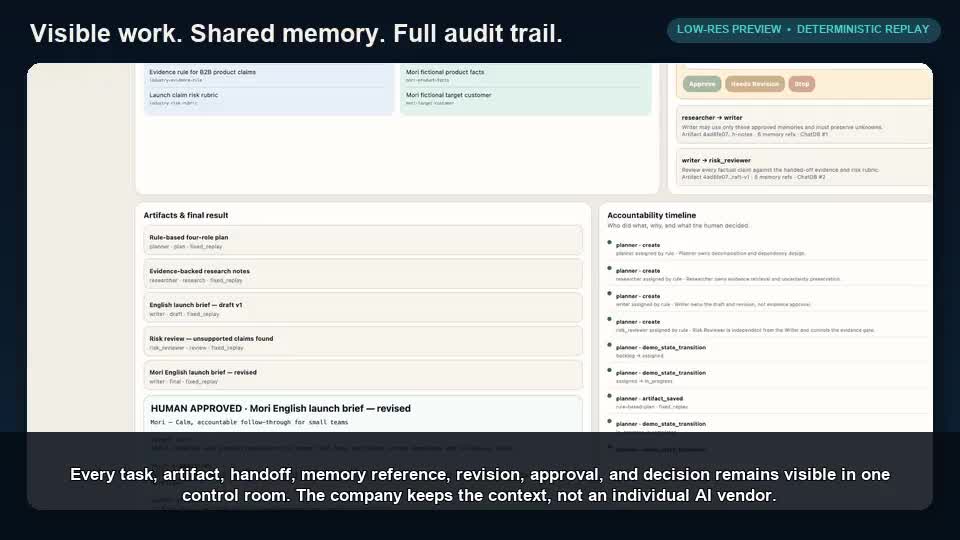
Source, destination, artifacts, memory references, and timestamps remain auditable.
Purpose and critical judgment are not delegated silently. Humans remain accountable.
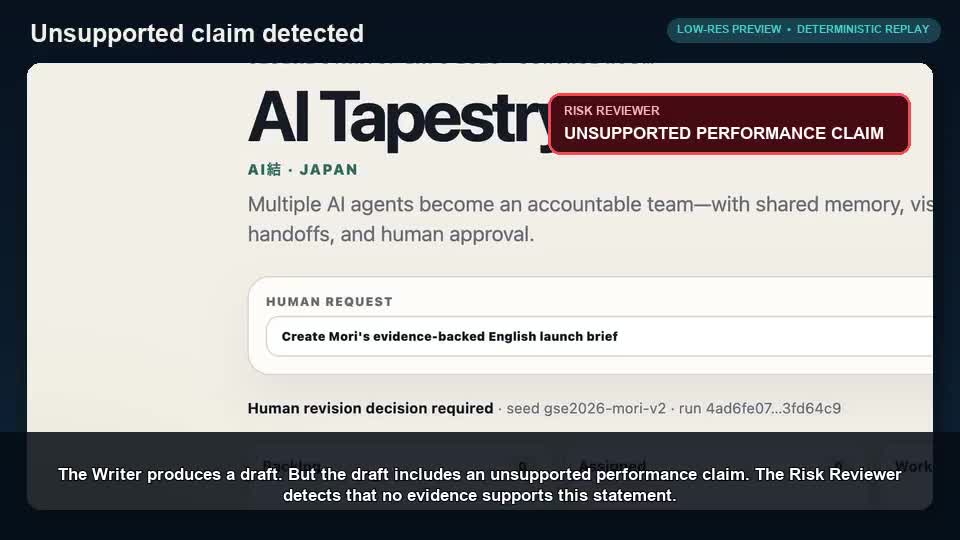
In the GSE 2026 scenario, a Planner, Researcher, Writer, and Risk Reviewer share knowledge and context, then stop an unsupported claim before human approval.
The Planner breaks one request into visible work.
The team begins with structured context, not an empty prompt.
The Researcher passes artifacts and references to the Writer.
A “30% sales increase” claim is stopped before publication.
The decision and its reason remain in the audit trail.
Features emerged from what AI members needed in real collaboration.
Organizational context should not be locked inside one AI vendor.
People can inspect work, evidence, handoffs, and decisions.
Humans retain goals, policy, approval gates, and the power to stop.
We do not compete with large platforms on feature count. We combine domain knowledge, organizational context, and practical workflow in a size that small professional teams can use from day one.
Connect research items, local rules, evidence, progress, and tax checkpoints through final expert review.
Coordinate document collection, decisions, confidentiality, and human review across tax and administrative work.
Help design, coding, research, and review agents collaborate without losing the history behind their work.
Founder & CEO / Representative Director
Licensed Tax Accountant, Administrative Scrivener, MBA, and AI Product Builder
I have worked in tax, inheritance, and administrative fields where accuracy, confidentiality, and human accountability are essential—while also building products with multiple AI teammates in daily practice.
AI Tapestry’s features were not selected only for human convenience. They were created from needs expressed inside the AI team: knowing what other members were doing, passing context without a human relay, and reviewing past successes and failures before beginning work.
AI Tapestry was not imagined as an AI team product. It emerged from working with an AI team.
Certain core concepts are patent-pending in Japan. Source code, retrieval logic, and internal coordination protocols remain proprietary.
We are seeking pilot partners in real estate and professional services, domain knowledge partners, technology collaborators, investors, and global market-entry partners.
Contact AI Tapestry